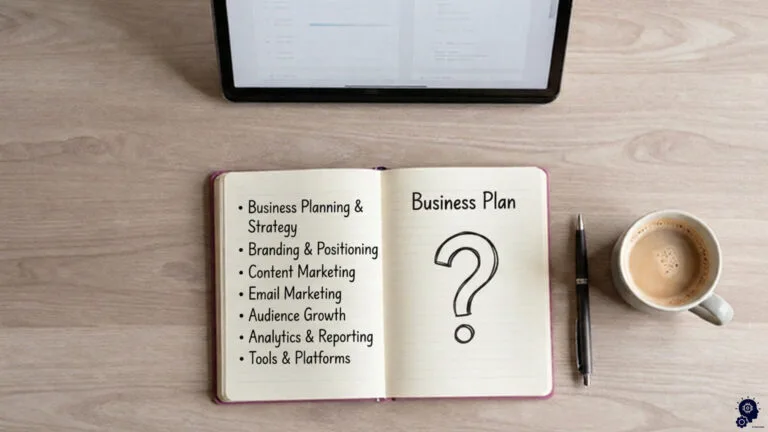
It started with a plan…
I stumbled across my business plan a few weeks ago. Not a current one — a proper, dated, “Version No.: 1.0 [Draft]” document from September 2017, written back when I was still deciding what kind of business I actually wanted to create. Reading it back nearly ten years later was a strange experience, somewhere between cringing and being quietly proud of myself for at least being structured about it.
The business in that plan was built around a network of small niche websites — one for black pudding, one for home décor prints, one for sailing merchandise, one dedicated entirely to the colour purple, among others. Each with its own domain, its own hosting, its own social accounts, all tied together by affiliate links and an email autoresponder. Looking back, it reads like someone trying to cast a very wide net and see what caught, rather than someone who’d worked out, or even considered, what they were actually good at. And I guess I knew that was true at the time.
Here’s the part I didn’t expect when I was looking through that old document: how much of it is working and in play. BlackPudding.Club is live, still ranks well, and still pulls in around 1,000 visitors a month — without a single new piece of content added in years. InspirationIsPurple was launched but achieved very little, until I gave it an overhaul at the end of 2024, and traffic has been gently climbing since. NauticalBits, the sailing merchandise site, is one that didn’t make it — I closed it down earlier this year, not because sailing merchandise was a bad niche, but because I simply wasn’t putting in the time it needed. It now lives on as a demo site in my portfolio rather than a live business.
So this isn’t a story about a plan that got abandoned for something better, it’s about a plan that served its purpose at a point in time but clearly needs an update.
What the old plan got right…
Whatever the weaknesses of that 2017 plan, the structure underneath it still holds up. It had a business description, a service offering, a marketing strategy, an operational plan broken into actual tasks, and a financial overview — overheads, initial investment, even a (slightly optimistic) income forecast built from traffic and conversion assumptions. That’s a proper plan skeleton, and I will still lean on the same headings today, just with the content behind them completely rewritten.
To begin with, it gave me a clear focus on what I wanted to achieve and how to go about it. It also forced me to deal with things I might otherwise have put off — registering as an auto-entrepreneur in France and thinking about what “legal structure” even meant for a one-person business — running a business here is a little more complex than the UK.
There are a number of points which can be marked “COMPLETED” in that old document, in among a lot of things that never got started or finished, so I find it satisfying to know I could add a few green ticks to a document created by a version of me who had no idea upon how the story was going to unfold.
The real failing wasn’t in the plan, it was in the execution…
If I’m honest about the overall success (or rather lack of) of the plan, it wasn’t the underlying idea, it was the execution. Black Pudding Club is proof that a decently built niche site with solid early SEO foundations can keep generating traffic on autopilot for years. InspirationIsPurple is proof that picking a neglected site back up and reinvesting even a little attention gets rewarded. The affiliate/content model in that 2017 plan wasn’t wrong — it worked, in places, but not in the way I’d intended.
What I didn’t have was the discipline to keep multiple sites ticking over with fresh content and active marketing all at once. Several niches meant multiple content calendars, multiple social presences, multiple sets of “the next article” — and realistically, one person can only give sustained attention to so many fronts before something has to give. The home décor sites and a couple of print-on-demand sites dropped by the wayside and as I previously mentioned Nautical Bits was eventually withdrawn.
That’s the lesson that’s actually shaped how I am working now, more than any of the tooling or strategy changes below: A couple of sites with regular content beats many sites with zero content.
What’s completely different now…
The biggest shift isn’t the foundation — it’s the shape of the business. The 2017 plan was built around anonymous niche sites where the reader never needed to know who was behind them. BMCS today is the opposite of that. I’m the business and I can now provide a service. BlackPudding.Club, InspirationIsPurple and NauticalBits won’t be disappearing — they’re now part of my site portfolio, some lasting proof from a decade’s worth of builds rather than just standalone businesses I’m juggling. This site is both the shop window and the portfolio, and increasingly it will become a knowledge library I’m building in public — a very different kind of content commitment to several separate blogs chasing multiple different audiences.
The tools have moved on too, obviously — Mailchimp and AWeber have given way to MailerLite, HostPapa to Hostinger, and “install XAMPP and hand-build a WordPress theme” has given way to a proper development workflow with staging environments and version control habits I didn’t have a decade ago. But the more interesting change isn’t the toolset, it’s the focus. One clear service offering, one clear audience, one site I actually control end to end, rather than a portfolio of small bets spread thin. Don’t get me wrong, I haven’t completely written off some of the ideas I had, I just know I need to have the time and processes in place to manage them effectively.
Additional research if I were starting today…
If I were writing Phase III of that plan now, rather than just reading Phase II with hindsight, the research list would look different, including:
- The potential impact of AI on business operations and services – given how fast that’s moving and how it is changing the way we do things
- Realistic client acquisition channels for a service business, rather than traffic-and-conversion maths built for an affiliate model
- What a modern, sustainable content calendar looks like for one person, not a small content farm and the best options for managing/automating that workflow
- VAT registration thresholds and reporting obligations for auto-entrepreneurs in France – the impact of BREXIT created a major shift from the original plan
- UK vs EU invoicing and currency handling for a genuinely cross-border client base – electronic invoicing is soon to be mandatory in France
The business landscape has changed dramatically since 2017 and, likewise, my skillset. It’s a decent reminder that a business plan isn’t a document you write once and file away — it provides a snapshot of what you knew and believed at a specific point in time, and becomes a tool for showing you how far you’ve come and highlighting key performance areas to be addressed. It should then be revised accordingly to reflect how you plan to achieve your current goals and objectives.
Business plan headings that still earn their place…
If you’re starting from scratch and wondering what actually belongs in a first business plan, here’s what’s survived the journey from that 2017 draft to something that remains as my default today and I’ll be using as I create my 2026 version with new goals in sight:
- Business description — who’s behind it, and why
- Service offering — what you actually do, described plainly
- Market / audience — who it’s for, and why they’d choose you
- Marketing strategy — how people will actually find you
- Operational plan — the practical, unglamorous task list
- Financial overview — overheads, investment, realistic income expectations
- Realistic capacity — how much ongoing marketing and content you can actually sustain, not just launch
- Implementation plan — a rough timeline, even if you know it’ll move
You don’t need all of it polished before you start. I certainly didn’t and probably won’t have this time around. What matters more, as I have learned, is being true to yourself about capacity — not just what you’d like to build, but what you can actively keep marketing and adding content to once the novelty wears off. That’s the one heading missing from my 2017 plan that I’ve added without hesitation today: realistic capacity, right alongside the financial forecast.